Encapsulated vibration motors vs enclosed which to use
Compare encapsulated vs enclosed vibration motors by IP rating (IEC 60529), thermal dissipation, haptic force (G-rms), and mounting for wearables & medical devices.
Key Takeaways:
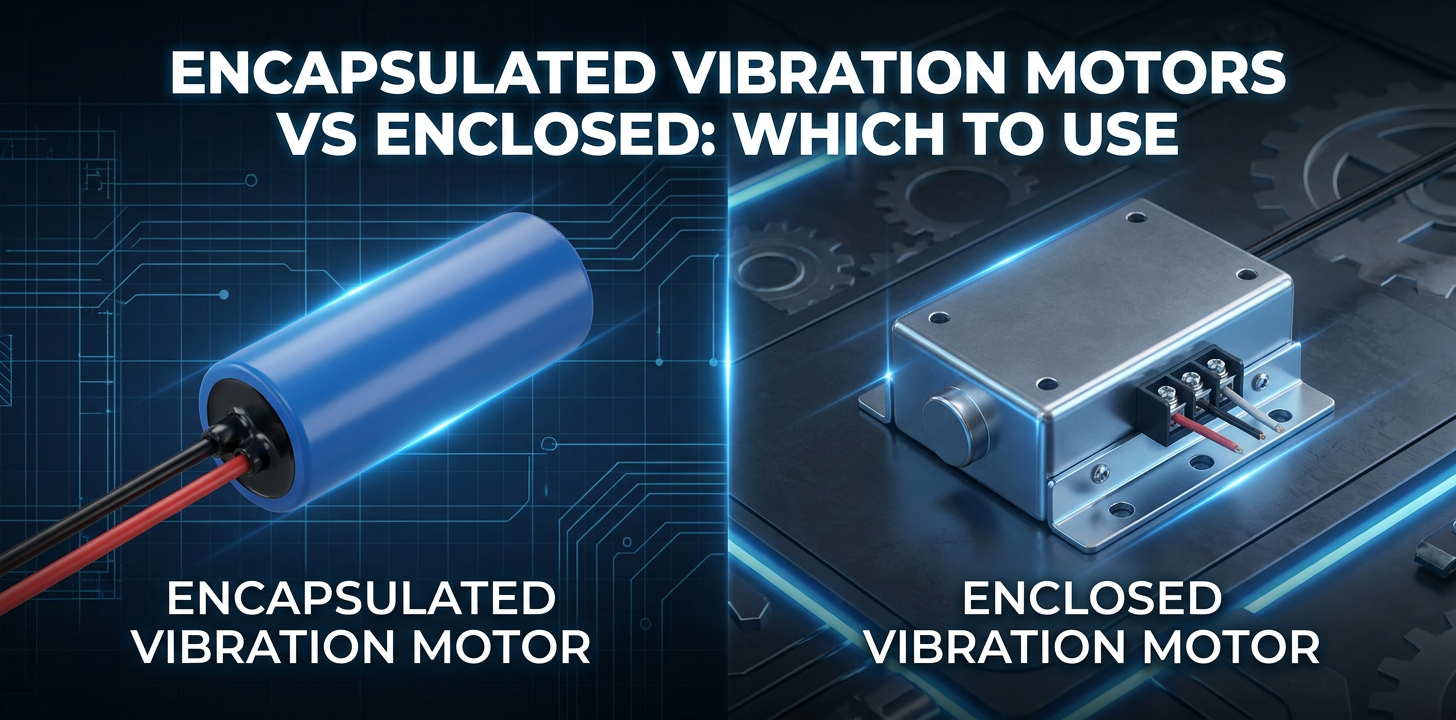
Encapsulated vibration motors feature a smooth, fully sealed outer capsule with epoxy potting at lead wire exits, making them ideal for direct low-pressure overmolding, resin potting, or continuous liquid immersion (IP67/IP68). Learn more about our specialized encapsulated vibration motor solutions.
Enclosed vibration motors house the internal motor within a protective casing that includes mounting brackets, screw holes, or mechanical seams—ideal for structural mounting and dust resistance (IP54 to IP65), but unsuited for direct overmolding.
Thermal & Haptic Trade-offs: Encapsulation provides structural protection but restricts direct air convection, requiring thermally conductive potting compounds. Added capsule mass can slightly attenuate peak G-rms haptic amplitude.
OEM Design-in: Reliable sealing depends as much on cable exit potting, connector mating, and PCB strain relief as it does on the core motor housing.
Introduction
Selecting the right tactile feedback actuator for a sealed handheld device, medical instrument, or outdoor wearable often comes down to environmental ingress protection. While standard micro DC motors operate reliably inside protected device housing, harsh environments exposed to water, dust, cleaning chemicals, or potting resins require specialized housing protection.
This guide provides an engineering breakdown of encapsulated vibration motors vs enclosed vibration motors, helping you select the optimal component architecture for your product hardware.
What You Will Learn
The physical and structural differences between encapsulated capsules and enclosed casings.
How IP ratings defined by IEC 60529 translate into real-world liquid and particulate resistance.
Key trade-offs across thermal dissipation, haptic acceleration output (G-rms), mechanical mounting, serviceability, and bill-of-materials (BOM) cost.
How Eccentric Rotating Mass (ERM) actuators behave under sealed overmolding and potting.
Practical Engineering Considerations
Beyond component-level specs, integrating sealed haptics requires evaluating how overmolding pressure impacts internal clearances, how thermal heat builds up under continuous duty cycles, and how cable lead exits maintain hermetic integrity during field use.
Definitions and IP basics
What “encapsulated” means
An encapsulated vibration motor consists of a core motor—typically a small cylindrical ERM vibration motor or coin actuator—completely encased inside a sealed outer capsule made of rigid plastic (such as blue ABS/polycarbonate) or metal (brass or stainless steel).
The critical engineering feature of an encapsulated motor is its hermetic sealing design. The end-cap where flying lead wires exit the housing is completely potted with thermosetting epoxy resin. Because the exterior casing has no open vent holes or exposed mechanical seams, encapsulated vibration motors are specifically designed to withstand direct low-pressure, low-temperature plastic overmolding (such as TPE/TPU overmolding) or complete immersion in resin potting compounds without liquid intruding into the internal rotor gap.
Outer Capsule Casing | Micro Motor Core | | Rotating Eccentric Mass | | ====> Epoxy Potted Lead Exit +--------------------+ +----------------------------+ | (Fully Sealed for Overmolding)
What “enclosed” means
An enclosed vibration motor houses the internal motor assembly inside a protective outer jacket or chassis, but it is not intended for direct resin potting or overmolding. Enclosed designs typically feature external mounting brackets, screw holes, or snap-fit flanges on the casing to simplify mechanical fastening directly to a product chassis or PCB.
While an enclosed casing protects the internal motor from mechanical impacts, debris, and casual handling, it often contains microscopic assembly seams or unpotted wire exit grommets. Under high liquid pressure or during plastic overmolding, molten resin or liquids can penetrate these micro-gaps, locking the internal rotating mass or short-circuiting the commutator.
IEC 60529 IP code essentials
To specify protection levels accurately, hardware engineers rely on the IEC 60529 Ingress Protection (IP) code rating system. The IP code uses a two-digit format (IPXX) to quantify environmental protection:
First Digit (Solid Particle Protection):
5: Dust-protected. Ingress of dust is not entirely prevented, but dust does not enter in sufficient quantity to interfere with satisfactory operation.6: Dust-tight. No ingress of dust; complete protection against contact.
Second Digit (Liquid Ingress Protection):
4: Protected against splashing water from any direction.5: Protected against water jets projected by a nozzle (6.3 mm) from any direction.6: Protected against powerful water jets (100 kPa pressure at 3 meters).7: Protected against the effects of temporary immersion in water (up to 1 meter depth for 30 minutes).8: Protected against continuous submersion in water under conditions specified by the manufacturer.
For micro vibration actuators:
Standard enclosed vibration motors generally provide IP54 to IP65 equivalent protection when integrated with external casing gaskets.
Properly designed encapsulated vibration motors deliver IP67 to IP68 capability, maintaining complete liquid barrier performance even when submerged or overmolded into custom silicone or thermoplastic housings.
Key differences and tradeoffs
Protection, thermal, haptics, serviceability
Choosing between encapsulated and enclosed architectures involves balancing environmental sealing against thermal shedding, haptic acceleration, and downstream assembly maintenance.
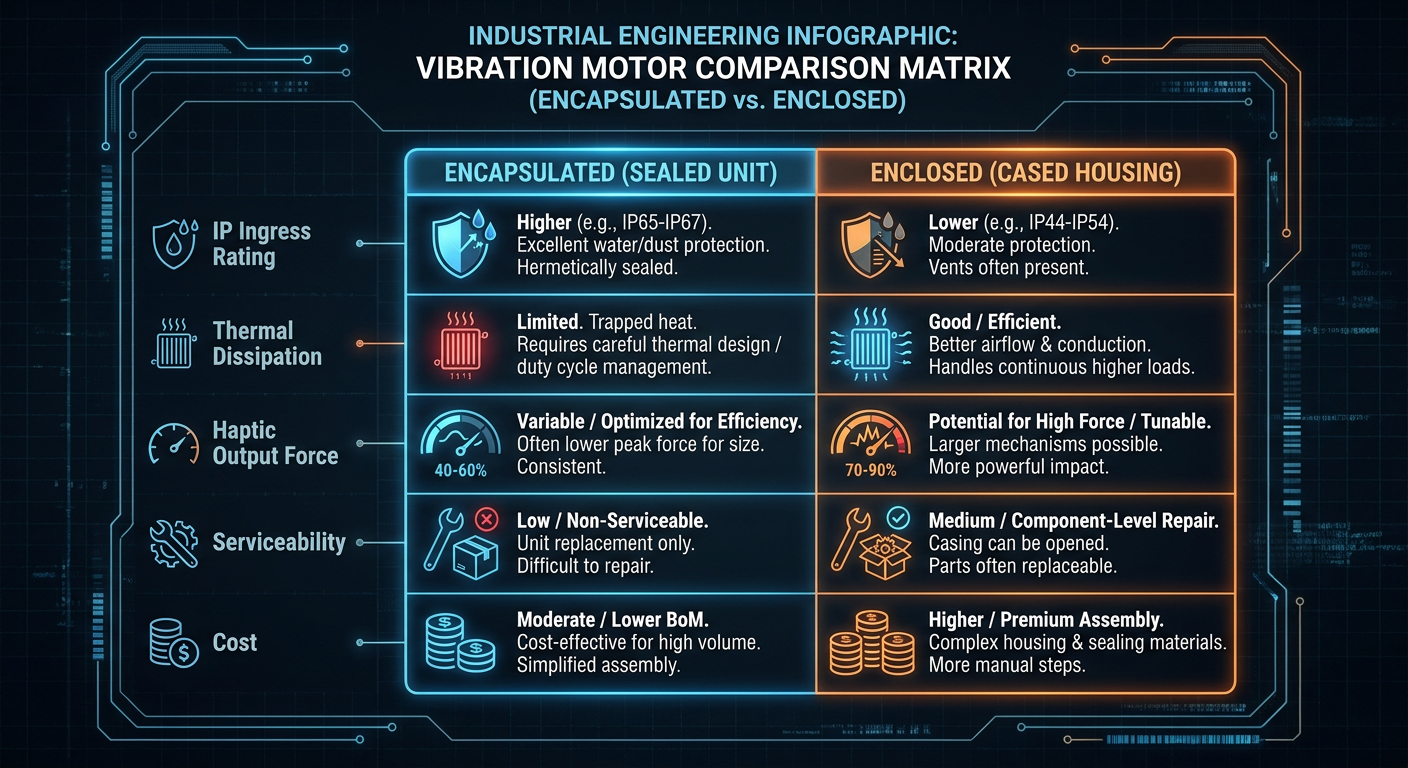
Parameter / Feature | Encapsulated Vibration Motors | Enclosed Vibration Motors |
|---|---|---|
Primary Ingress Rating | IP67 / IP68 (Waterproof & Dust-tight) | IP54 to IP65 (Splash-resistant & Dust-protected) |
Overmolding / Potting | Suitable for low-pressure overmolding & resin potting | Not suitable for direct overmolding (risk of resin entry) |
Thermal Dissipation | Relies on thermal conduction through potting epoxy & capsule | Uses air gaps and casing conduction; better for low continuous heat |
Haptic Output Efficiency | Added capsule mass slightly dampens peak G-rms amplitude | Preserves original motor mass ratio; direct force transfer |
Mechanical Mounting | Overmolded into body, potted, or seated in custom foam cavities | Integrated screw tabs, mounting holes, or molded bracket slots |
Serviceability & Rework | Non-serviceable once potted/overmolded | High serviceability; easily unbolted or unclipped |
Relative BOM Cost | Moderate (includes capsule shell & epoxy potting labor) | Low to Moderate (standard housing assembly) |
Thermal Dissipation Considerations
Vibration motors generate internal resistive heating within their copper windings. Because encapsulated motors eliminate internal airflow, continuous operation can trap heat unless the outer capsule conducts heat directly into the host enclosure. Using thermally conductive epoxy potting compounds (with thermal conductivities between 0.8 and 1.5 W/m K) helps transfer heat away from the stator to the external environment.
Haptic Output & Acceleration (G-rms)
The felt vibration intensity of a motor mounted to a device of mass M device is governed by Newton's second law:
a peak = F centrifugal / M total = (m eccentric * r * w²) / (M device + m capsule)
Enclosing a motor inside an external metal capsule increases the dead mass of the actuator assembly. As a result, an encapsulated motor requires slightly higher input drive voltage or a larger internal eccentric mass to deliver the exact same net peak acceleration (G-rms) as a bare or light-housed enclosed motor.
Sealing considerations for ERM actuators
Understanding how eccentric mass motors behave under sealed conditions is essential when selecting your motion mechanism:
Eccentric Rotating Mass (ERM) Motors: ERM motors generate multi-directional vibration perpendicular to the rotation axis by spinning an unbalanced mass.
Internal Clearance Requirements: The capsule internal cavity must provide sufficient radial mechanical clearance so the rotating eccentric weight never contacts the capsule inner wall during vibration. High-quality waterproof encapsulated vibration motors achieve this by housing the core motor inside a rigid metal or polycarbonate shell before applying epoxy end-seals.
Overmolding Protection: When designing overmolded assemblies, maintaining rigid outer capsule walls prevents molten TPU/TPE plastics from deforming the housing and locking the rotating eccentric mass.
Cost, validation, and lifecycle impact
While encapsulated vibration motors carry a slightly higher upfront component unit cost due to secondary epoxy potting operations and capsule hardware, they frequently reduce total system-level manufacturing costs. By eliminating the need for complex internal elastomeric gaskets, custom sealing O-rings, and manual adhesive dispensed around motor compartments, encapsulated designs streamline final assembly.
From a reliability perspective, encapsulated units protect against internal coil corrosion caused by moisture condensation, salt spray exposure, or sweat accumulation, significantly extending operational lifespan in harsh outdoor environments.
Application selection guide
Wearables and consumer haptics
Wearable devices—such as fitness bands, smart rings, outdoor GPS trackers, and haptic vests—require reliable vibration alerts while maintaining slim footprints and complete resistance to sweat and water immersion.
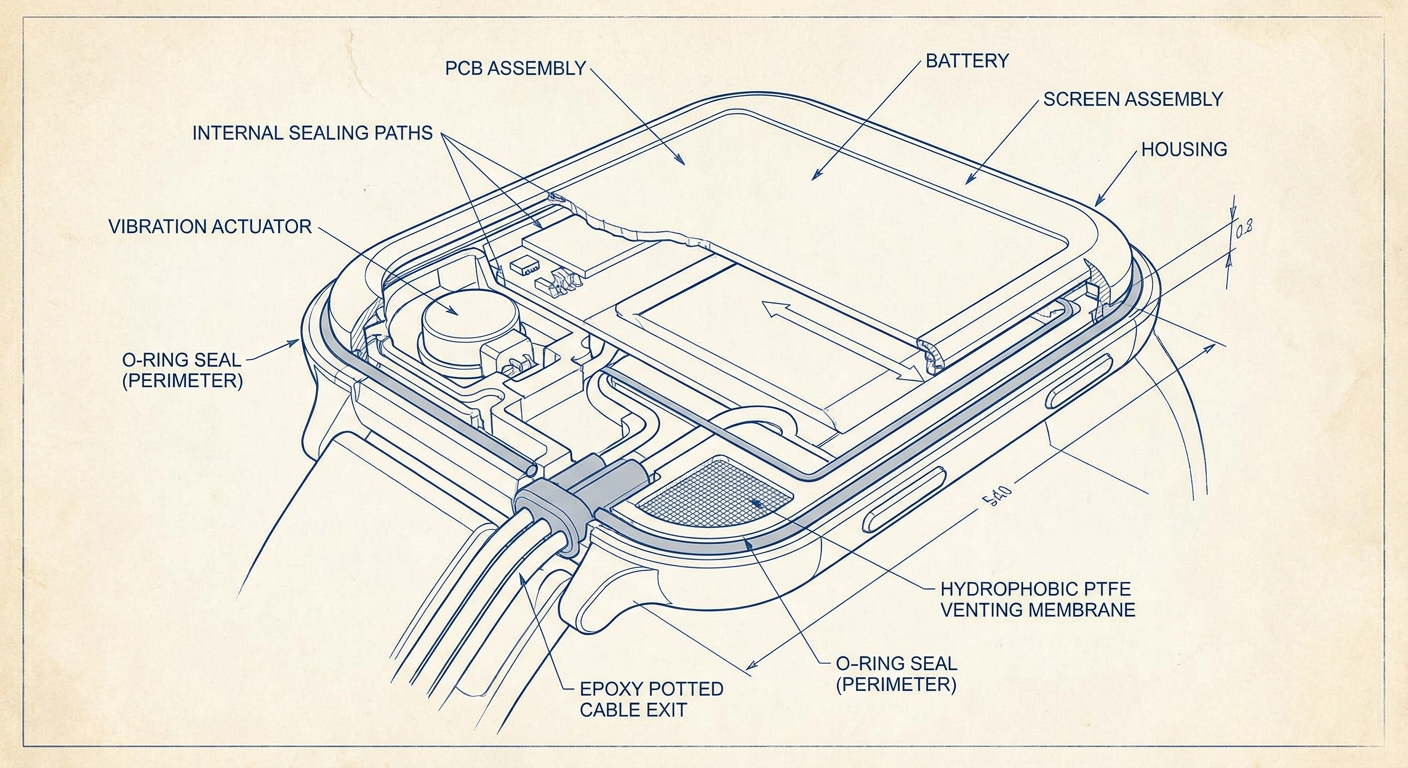
Integration Best Practices for Wearables:
Actuator Placement: Mount the encapsulated motor securely against the rigid inner wall of the wearable chassis using high-tack pressure-sensitive adhesive (PSA) or custom silicone boots to maximize haptic energy transfer to the user's skin.
Cable Strain Relief & Exit Sealing: Ensure lead wire exit points feature strain-relief loops and secondary RTV silicone sealant where leads pass through internal enclosure walls.
Pressure Equalization: When overmolding wearables, use hydrophobic PTFE membrane vents to prevent internal pressure spikes during high-temperature molding cycles.
Medical devices and cleanability
Medical equipment—including handheld surgical monitors, patient wearable diagnostic pumps, and rehabilitation devices—demands strict hygiene, chemical resistance, and IP67/IP68 liquid tightness to withstand repeated chemical disinfection (e.g., isopropyl alcohol, hydrogen peroxide wipes, or sodium hypochlorite washing).
When specifying motors for medical electronics, sourcing engineers require components backed by rigorous quality management systems (such as ISO 9001 and ISO 13485 compliance) and flexible customization options.
For specialized medical and industrial requirements, INEED Electronics offers comprehensive design-in capabilities across both encapsulated and enclosed motor architectures:
Customized Encapsulated & Enclosed Motors: Custom lead wire lengths, specialized miniature connectors (e.g., JST, Molex, or fine-pitch FPC), custom operating voltages, and tailored capsule geometry.
Rapid Prototyping (~5 Days): Engineering sample delivery delivered in as little as 5 business days to accelerate EVT/DVT testing cycles.
Sealed Interconnect & IP Validation: Complete support for IP67/IP68 ingress testing, custom potted cable harnesses, thermal cycle exposure, and reliability testing.
Pro Tip: In medical device integration, always verify that the capsule material (e.g., medical-grade stainless steel or biocompatible polycarbonate) is chemically compatible with the cleaning agents used in clinical environments.
Automotive HMI and rugged handhelds
Industrial handheld terminals, ruggedized logistics scanners, marine navigation controllers, and automotive steering wheel haptic feedback systems operate under severe environmental stress:
Thermal Extremes: Ambient operating temperatures ranging from -40°C to +85°C.
Mechanical Shock & Drop Resistance: Repeated free-fall impacts (e.g., 1.5-meter drop tests onto concrete) and continuous industrial vibration.
Chemical Exposure: Exposure to automotive oils, hydraulic fluid, and high-pressure washdown jets (IP69K requirements).
In these rugged applications, encapsulated vibration motors with reinforced metal shells and heavy-duty silicone-jacketed leads prevent lead wire fatigue and internal magnet dislocation under heavy mechanical shock.
Conclusion
Quick Decision Matrix
To finalize your motor selection, follow these practical engineering decision cues:
Choose Encapsulated Vibration Motors when:
The motor will be directly overmolded with TPE/TPU plastics or potted in liquid epoxy resin.
The end device requires certified IP67 or IP68 waterproof performance for submersion or washdown.
The motor is deployed in corrosive environments, high-humidity zones, or sweat-exposed wearables.
Minimal internal device space is available for custom perimeter gaskets or sealing O-rings.
Choose Enclosed Vibration Motors when:
The motor must be mechanically fastened via screw tabs or chassis mounting holes for easy field maintenance.
Lower component unit cost is required and the main device housing already provides a sealed outer shell.
The motor operates under continuous duty cycles where direct air convection or housing contact is needed for thermal management.
Final Verification Checklist
Before releasing your design for tooling:
Perform Assembly-Level IP Testing: Validate ingress protection on fully assembled EVT prototypes, paying close attention to cable exit potting and housing seam compression.
Conduct Thermal Rise Modeling: Test motor winding temperature rise under worst-case duty cycles inside the final sealed enclosure.
Verify Haptic Acceleration: Measure net G-rms acceleration on the final weighted device chassis using an accelerometer to ensure tactile feedback meets user experience guidelines.
Frequently Asked Questions (FAQ)
1. What is the difference between encapsulated and enclosed vibration motors?
Encapsulated vibration motors are fully sealed inside a smooth outer shell with epoxy resin potting at lead wire exits, making them waterproof (IP67/IP68) and directly suitable for low-pressure plastic overmolding or liquid resin potting. Enclosed vibration motors feature external protective housings with mounting tabs or screw holes (IP54 to IP65), designed for mechanical mounting inside a device chassis rather than direct plastic overmolding.
2. Can encapsulated vibration motors be directly overmolded with TPE or TPU?
Yes, encapsulated vibration motors are specifically engineered to withstand low-pressure, low-temperature overmolding (such as TPE/TPU injection) and epoxy resin encapsulation without liquid penetrating into the internal rotor gap or jamming the rotating eccentric mass.
3. How does encapsulation affect haptic vibration performance (G-rms)?
Adding an outer capsule shell slightly increases the dead mass of the actuator assembly. According to Newton's second law ($a_{\text{peak}} = F / M_{\text{total}}$), this extra mass slightly dampens peak acceleration. To achieve identical G-rms output, designers can select a slightly larger eccentric mass or increase the drive voltage appropriately.
For complete motor specifications, technical datasheets, and engineering sample requests, explore the comprehensive micro vibration motor catalog from INEED Electronics.